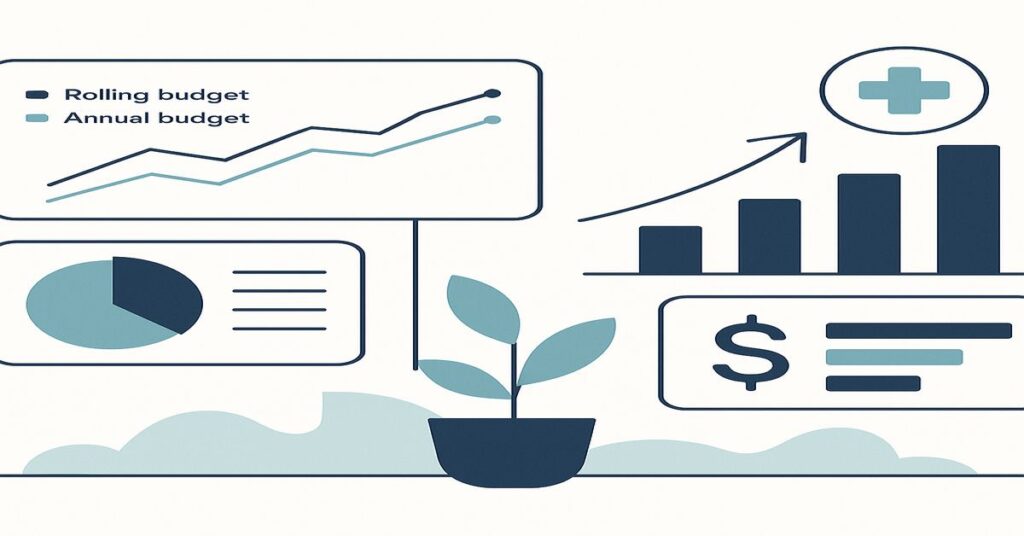
You’re juggling patient volumes, reimbursement changes, staffing shortages, and leaders who want the future now. Choosing between a rolling budget and an annual budget can feel like picking the right lifeline—and the wrong choice wastes time and margin.
If this is your world, you’re not alone—here’s how healthcare leaders are fixing it.
Keywords: primary: “rolling vs. annual budgets”; long-tail: “rolling budget healthcare finance”, “annual budget vs rolling budget for hospitals”, “rolling forecasts and budgets for healthcare operations”. These phrases appear naturally below to help your team find the right approach.
Summary: The right choice isn’t ideological. Use an annual budget for long-term strategy and capital planning; adopt rolling budgets (or rolling forecasts) when your operating environment is volatile and leaders need timely decisions. With a simple 4-step framework, most healthcare finance teams can cut cycle time, raise variance accuracy, and start showing value in 30 days.
What’s the real problem? (Rolling vs Annual Budgets)
Finance teams in hospitals and health systems face two hard truths: data is changing faster than your budget cycle, and leaders still expect dependable numbers. Annual budgets were built for stability. Today’s environment needs agility.
- Symptom: Forecasts feel outdated within weeks—volume or payer mix shifts make the numbers stale.
- Symptom: Budgeting consumes months of FTE time every quarter close and planning season.
- Symptom: Leaders distrust the numbers and ask for ad-hoc scenario runs—manual, slow, error-prone.
- Symptom: You can’t link operational KPIs (like occupancy, A/R days) back to the budget quickly.
What leaders get wrong
Leaders often treat rolling budgets and annual budgets as mutually exclusive. That’s a false binary. The other mistake is overcomplicating the switch—thinking it requires rip-and-replace of systems or a huge headcount increase.
- Pitfall: Thinking rolling = no discipline. Rolling budgets still need governance and version control.
- Pitfall: Trying to automate everything at once. Quick wins come from focused process and data fixes.
- Pitfall: Ignoring the human element—operations and clinical leaders need simple, trusted metrics, not spreadsheets.
Cost of waiting: each quarter you stay with stale numbers, you risk missed revenue opportunities and slower responses to payer changes—often measurable in low-to-mid single-digit margin hits over a year.
A better approach
Rather than “rolling vs. annual budgets,” think hybrid: keep an annual financial plan for strategy and capital, and run a short-cycle rolling forecast for operational control.
Follow this 4-step framework.
- Define decision windows. Map which decisions need 12-month strategic budgets (capital, long-term hiring) and which need 13–26 week rolling forecasts (staffing, supply purchasing, clinic hours).
- Simplify inputs. Identify 5–8 drivers (volume by service line, average reimbursement, staffing FTEs, supply cost indexes). Make those drivers single source of truth in your models.
- Automate dataflows. Connect your ADT, billing, and general ledger data to a lightweight planning model. Start with daily or weekly feeds for critical drivers; expand from there.
- Govern and communicate. Set a monthly cadence with operations: a 30-minute review, 1–2 agreed scenarios, and a decision log. Keep the conversation about actions, not spreadsheets.
Real-world proof: one regional hospital group using this hybrid approach reduced budgeting cycle time and manual reconciliation and started producing actionable rolling forecasts each month—leading to faster staffing reallocations and clearer variance explanations. Want a 15-minute walkthrough of this approach?
Quick implementation checklist
- List the top 8 drivers that move margin in your system this quarter.
- Map who owns each driver (operational leader + finance partner).
- Set a 4-week pilot: weekly data pull, one simplified rolling forecast, one leader review.
- Connect one data feed (ADT or billing summary) into a planning model or BI dashboard.
- Create a one-page variance template for the monthly review: actual vs forecast vs prior month.
- Limit scenarios to three: base, downside (-5% volume), upside (+5% volume).
- Agree on decision triggers (e.g., >3% margin variance triggers staffing review).
- Document assumptions and date them—so your team can audit changes easily.
What success looks like
Here are measurable outcomes finance leaders should target within 60–90 days of a focused rollout:
- Forecast accuracy improves: target a 10–20% reduction in variance to budget for key service lines.
- Cycle time: cut monthly forecasting effort by 30% or more through automation and simplified inputs.
- Decision velocity: move from ad-hoc to monthly action reviews with defined triggers.
- Cost to produce the budget: reduce hours spent in planning season by 25%.
- Leader trust: fewer escalations and faster approvals for operational shifts.
Risks & how to manage them
Top three risks—and how to mitigate them.
- Risk: Data noise creates churn. Mitigation: stabilize one authoritative feed (e.g., GL or billing summary) before adding more.
- Risk: Scope creep—teams ask for more scenarios. Mitigation: cap scenarios to three and enforce decision triggers.
- Risk: Tool paralysis—buying a big FP&A suite before process changes. Mitigation: pilot the process with BI + lightweight planning model; buy only if the pilot scales.
Tools & data
Practical tool mix many teams use: finance automation for GL consolidation, Power BI (or equivalent) for operational dashboards, and a lightweight planning layer for driver-based forecasts.
Social proof: a Finstory client trimmed monthly close time and reconciliation workstreams after automating feeds and aligning drivers—freeing CFO time for strategic planning.
Soft CTA: If you want, we can show an example Power BI dashboard that ties ADT to margin by service line.
FAQs
Q: Should we abandon the annual budget entirely?
A: No. Keep an annual plan for strategy, capital, and long-range commitments. Use rolling forecasts for operational agility.
Q: How often should a healthcare system run rolling forecasts?
A: Start monthly, move to every 2–4 weeks for high-volatility areas (ED volumes, OR schedules) once you have reliable feeds.
Q: Will this require new headcount?
A: Not necessarily. Early wins usually come from reallocating existing FP&A time to driver management and automating manual reconciliations.
Q: Can we measure ROI quickly?
A: Yes. Track hours saved in planning, change in forecast variance, and any margin improvements from faster operational decisions—many teams see tangible wins in 30–90 days.
Next steps
If you’re ready to decide between a rolling budget and an annual plan for your organization, start with a short consult. We’ll map your high-impact drivers, sketch a 30–60–90 day pilot, and show what success measures to track.
Book a quick consult and talk through your workflow—let us help you choose the right balance between rolling vs. annual budgets for your healthcare operations. Start seeing value in 30 days.
Work with Finstory. If you want this done right—tailored to your operations—we’ll map the process, stand up the dashboards, and train your team. Let’s talk about your goals.
Internal resources you may find helpful: Rolling Forecast vs Annual Budget (Finstory blog), Finstory FP&A Services, Case study: hospital close time improvement.
📞 Ready to take the next step?
Book a 20-min call with our experts and see how we can help your team move faster.
Prefer email or phone? Write to info@finstory.net
or call +91 44-45811170.